



Grid intelligence
Utilities are drowning in grid data and starving for grid intelligence.
Business intelligence did this for enterprise data. Grid intelligence does it for the grid.
The definition
What is grid intelligence?
Grid intelligence is the structured, decision-ready understanding of a power grid — its condition, risk, capacity, and value — produced by continuously turning the data a grid generates into AI-analyzed insight that utilities use to operate, maintain, and invest in their networks at scale.
Why now: the data exists. The intelligence does not yet.
Aging infrastructure, rising electricity demand, and the energy transition are loading grids faster than utilities can manually understand them. Closing that gap takes four steps, each adding meaning the one before cannot provide alone.
1
Data foundation
2D and 3D sensor data from drones and helicopters, plus back-end system records. On its own, this is cost.
2
AI analysis
Domain-specific computer vision and LiDAR models detect defects, classify severity, and read asset condition. Raw data becomes signal.
3
Structured intelligence
Findings become a consistent, queryable, network-wide record of condition, inventory, vegetation, capacity, and risk.
4
Decision and investment intelligence
The structured picture drives the choices utilities make: maintenance priorities, capacity, expansion and renovation, compliance and resilience.
Inspection generates the data. Grid intelligence generates the decisions.
The problem, from ten perspectives
Why utilities need grid intelligence
Utilities do not simply need to inspect more assets. They need to turn fragmented asset evidence into structured grid intelligence, so they can operate, invest, and future-proof the grid with greater confidence.
Part 1
Why the old model is under pressure
The grid is changing faster than traditional operating practices can absorb.
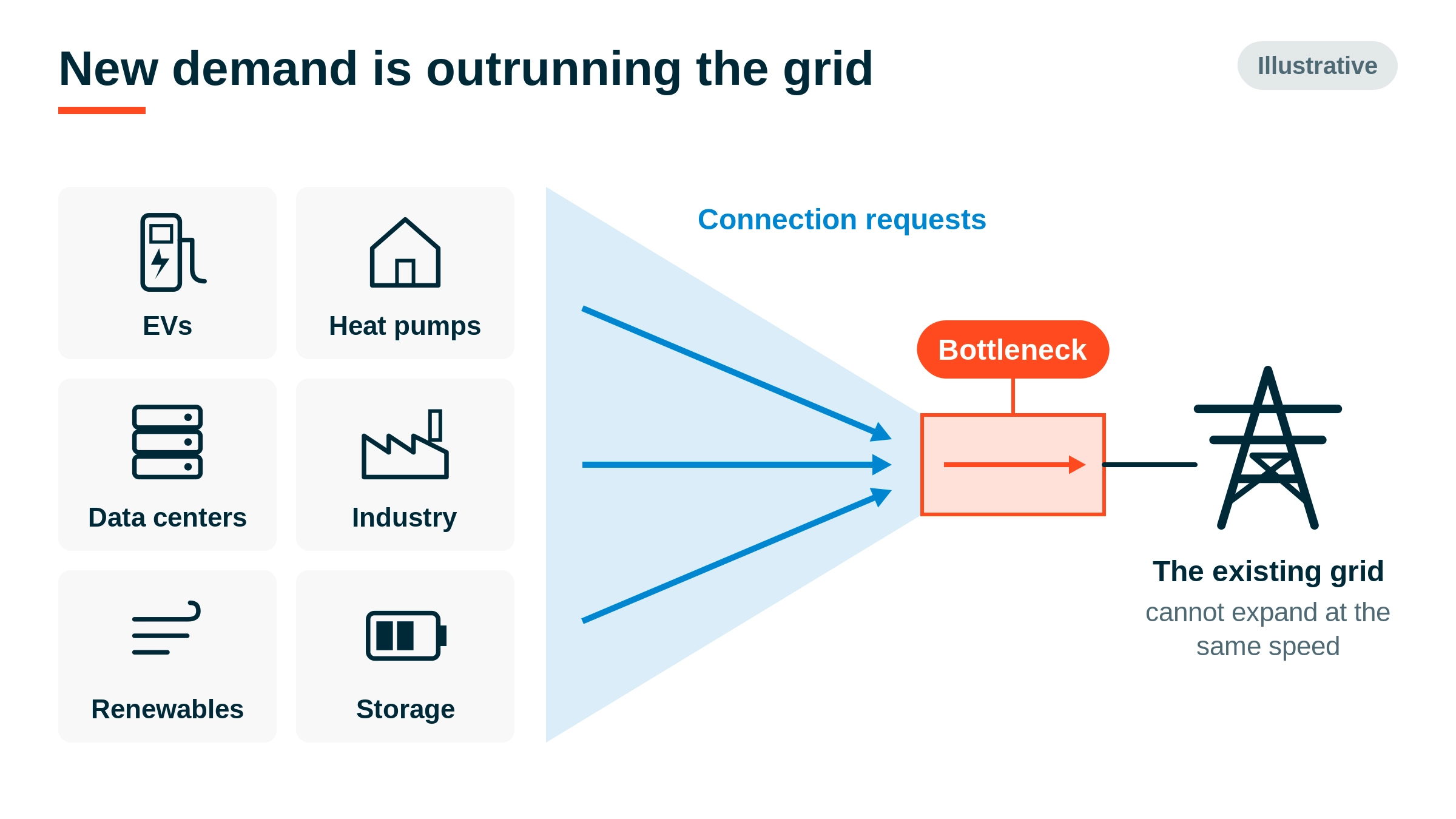
The grid is becoming the bottleneck of electrification
EVs, heat pumps, data centers, new industry, renewables, and storage are all competing for a grid that cannot be expanded at the same speed. Building more is only part of the answer. Utilities also need to know where capacity, condition, and risk constrain the network today, and where intervention creates the most value.
- Demand and connection requests are becoming more dynamic and less predictable.
- Reinforcement cannot always keep pace with new generation and load.
- Getting more from existing infrastructure takes asset-level and network-level intelligence.
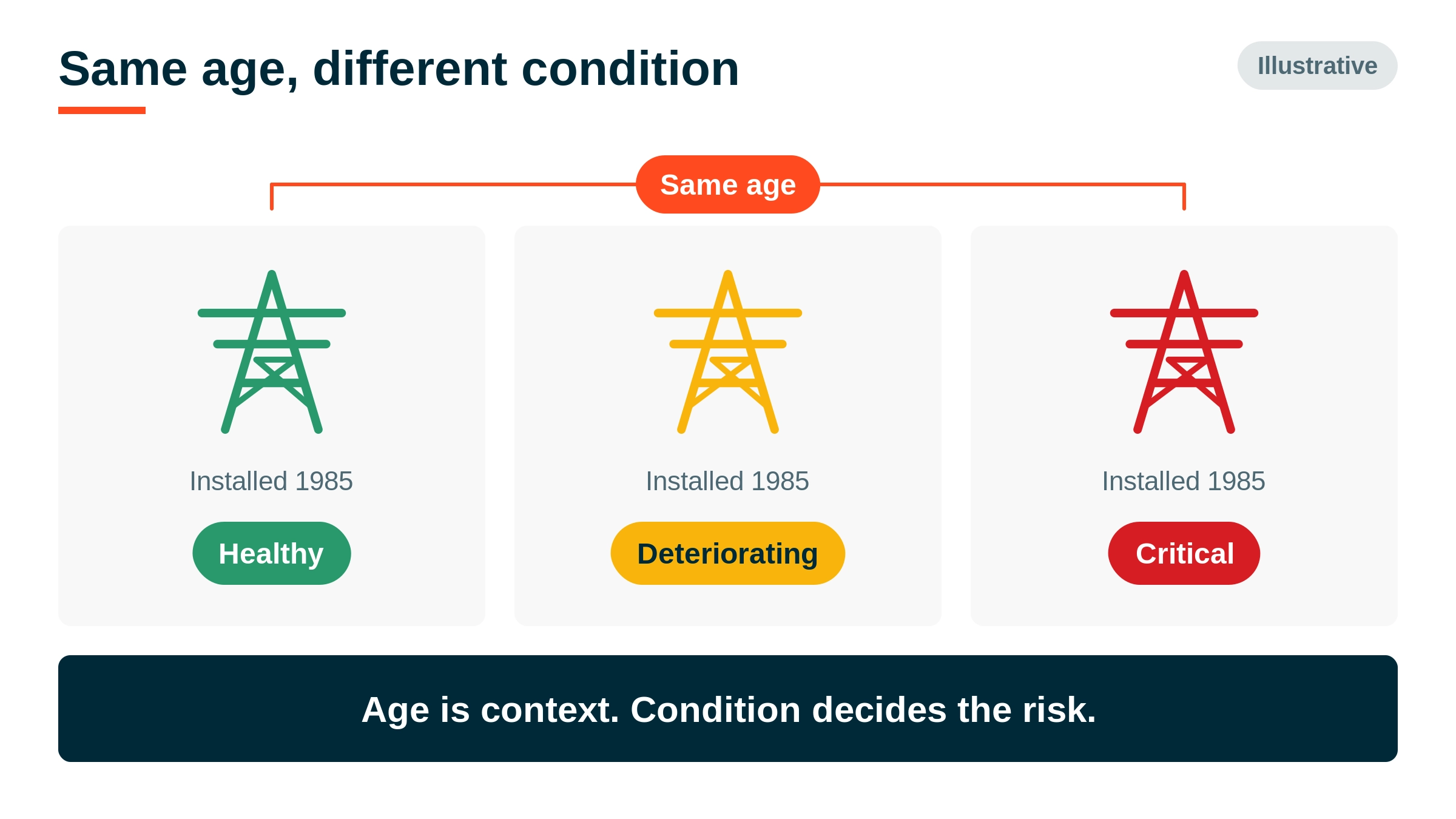
Aging assets are creating invisible operational risk
Age alone says little about condition. Two assets installed in the same year can deteriorate very differently depending on load, environment, corrosion, and maintenance history. The real problem is not knowing which assets are becoming risky, how fast, and what a failure would mean.
- Age is useful context, but it is not condition or probability of failure.
- Deterioration can stay hidden between inspection cycles.
- Condition intelligence directs intervention to where risk is rising and spares healthy assets from early replacement.
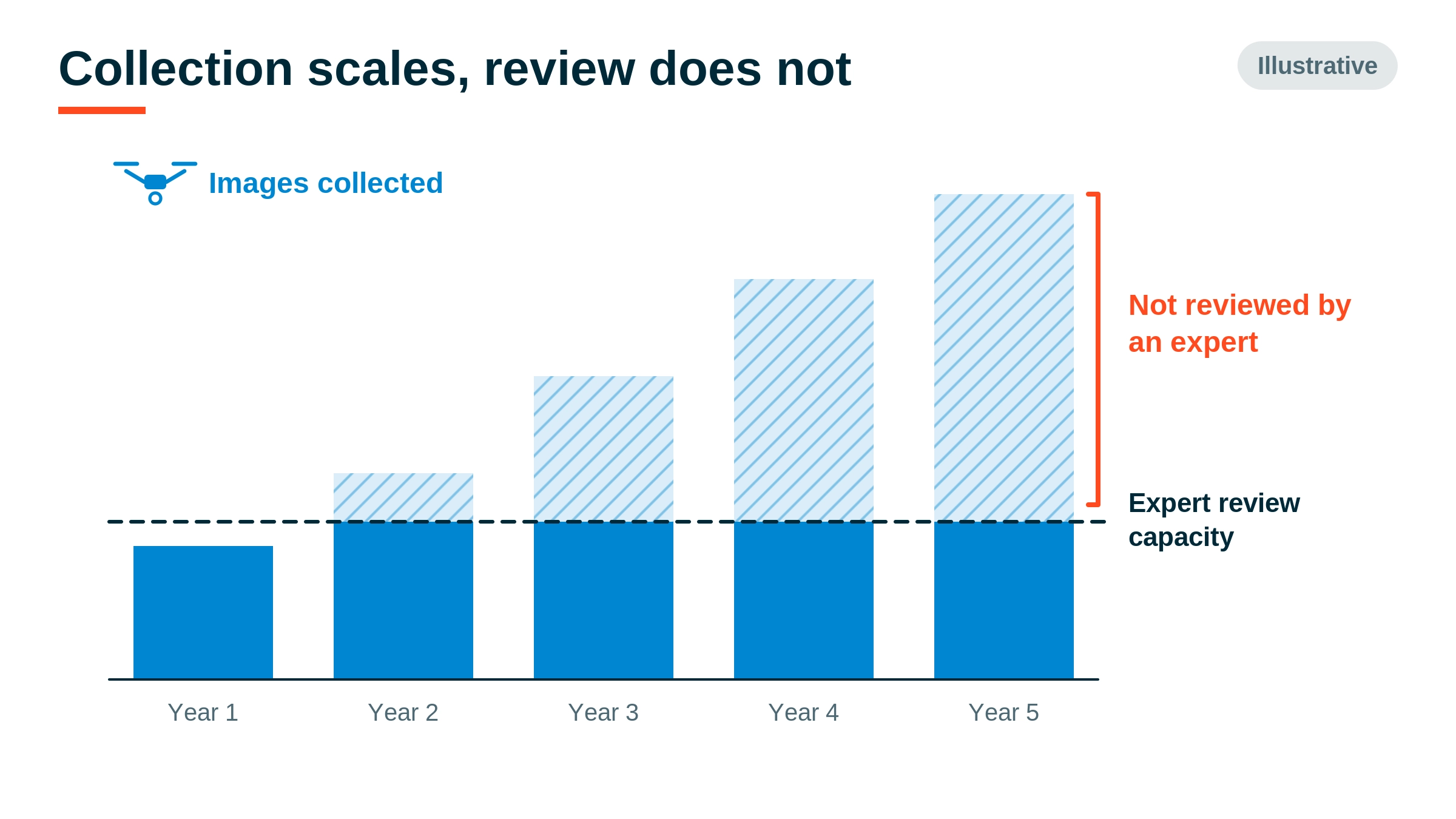
Manual inspection is no longer enough
Field crews, drones, helicopters, and thermal cameras now collect more inspection evidence than ever, yet reviewing it is still largely manual. Collection scales; expert review does not. The answer is not to replace inspectors. It is to let automation screen and structure the evidence, so specialists can focus on the ambiguous, high-consequence calls.
- Data collection has scaled faster than expert review capacity.
- Manual analysis brings delays and inconsistent classification and severity assessment.
- AI structures, screens, and prioritizes evidence. People stay accountable for the decision.
Part 2
Why utilities need structured asset intelligence
More data and more inspections only create value when evidence can be structured, compared, prioritized, and acted on.

Utilities are drowning in visual data but starving for structured intelligence
More images do not mean more knowledge. Evidence spread across reports, PDFs, folders, spreadsheets, and vendor portals is hard to reuse when it is not linked to assets, locations, defect types, severity, and history. A utility can hold vast amounts of visual data and still struggle to say what is changing across its grid.
- Images are evidence, not operational records or decisions.
- Without consistent asset linkage and taxonomy, observations cannot be compared across time, teams, or suppliers.
- The value lies in connecting evidence to risk, maintenance, and investment workflows.

Incomplete asset inventories are undermining grid planning
GIS, asset management systems, engineering drawings, inspection records, and field reality often disagree about what exists, where it is, and how it is identified. Those gaps weaken everything downstream, from inspection planning and risk modeling to regulatory reporting and capital plans.
- Different systems describe the same grid at different levels of detail, with different identifiers.
- Missing, duplicated, misclassified, or poorly located assets distort inspection, maintenance, and planning.
- A reliable inventory is a living capability, continually validated against the physical network.
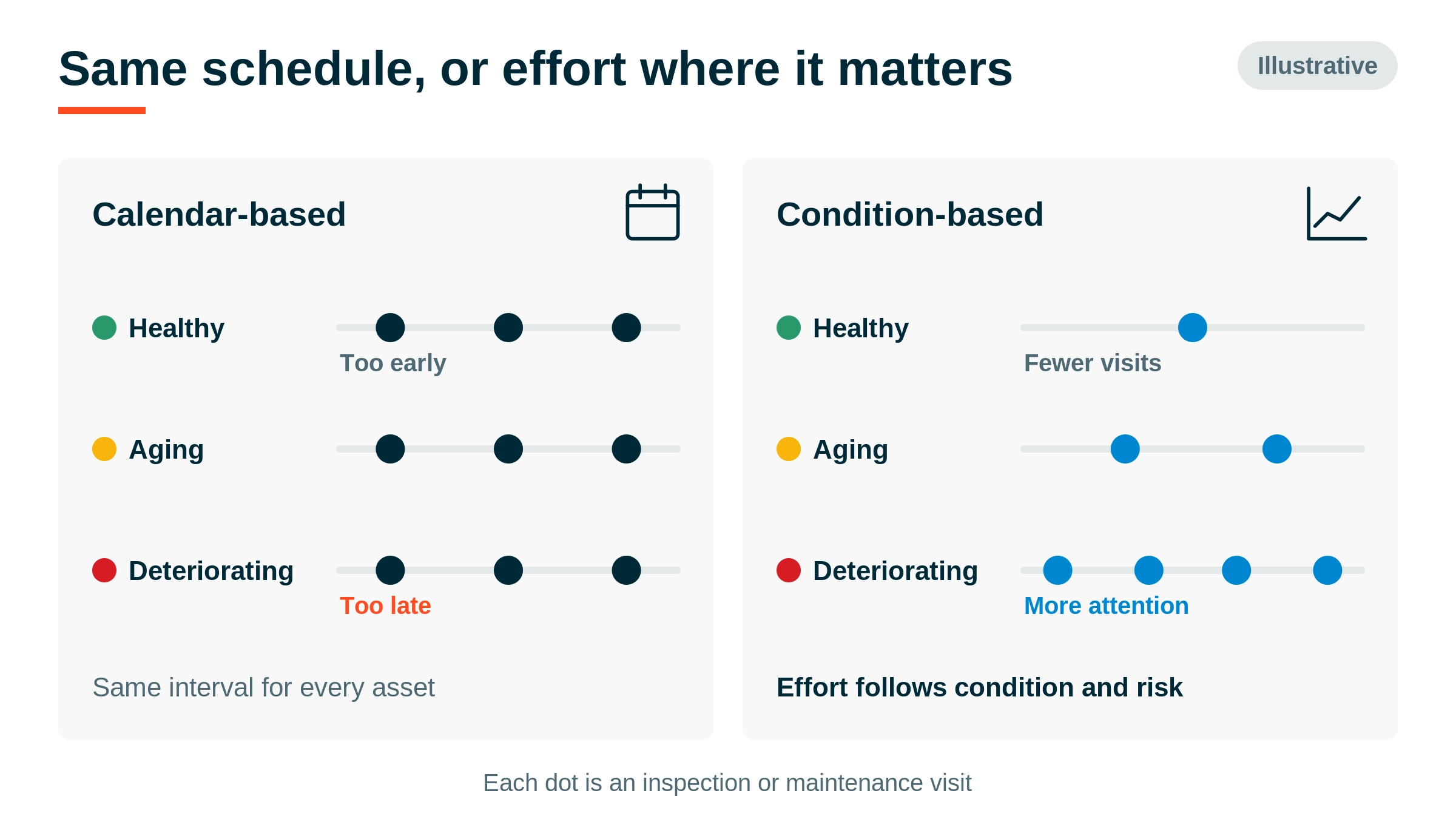
Maintenance is shifting from calendar-based to condition-based
Fixed intervals are predictable, but they assume similar assets deteriorate in similar ways. They do not. A uniform schedule reaches healthy assets too early and fast-deteriorating ones too late. Condition-based asset management uses current evidence to set inspection, maintenance, and replacement priorities.
- Uniform intervals are simple to govern but can spend scarce resources inefficiently.
- Condition-based decisions depend on trusted observations and a view of change over time.
- The realistic future is hybrid: preventive, compliance-driven, condition-based, and corrective work combined.
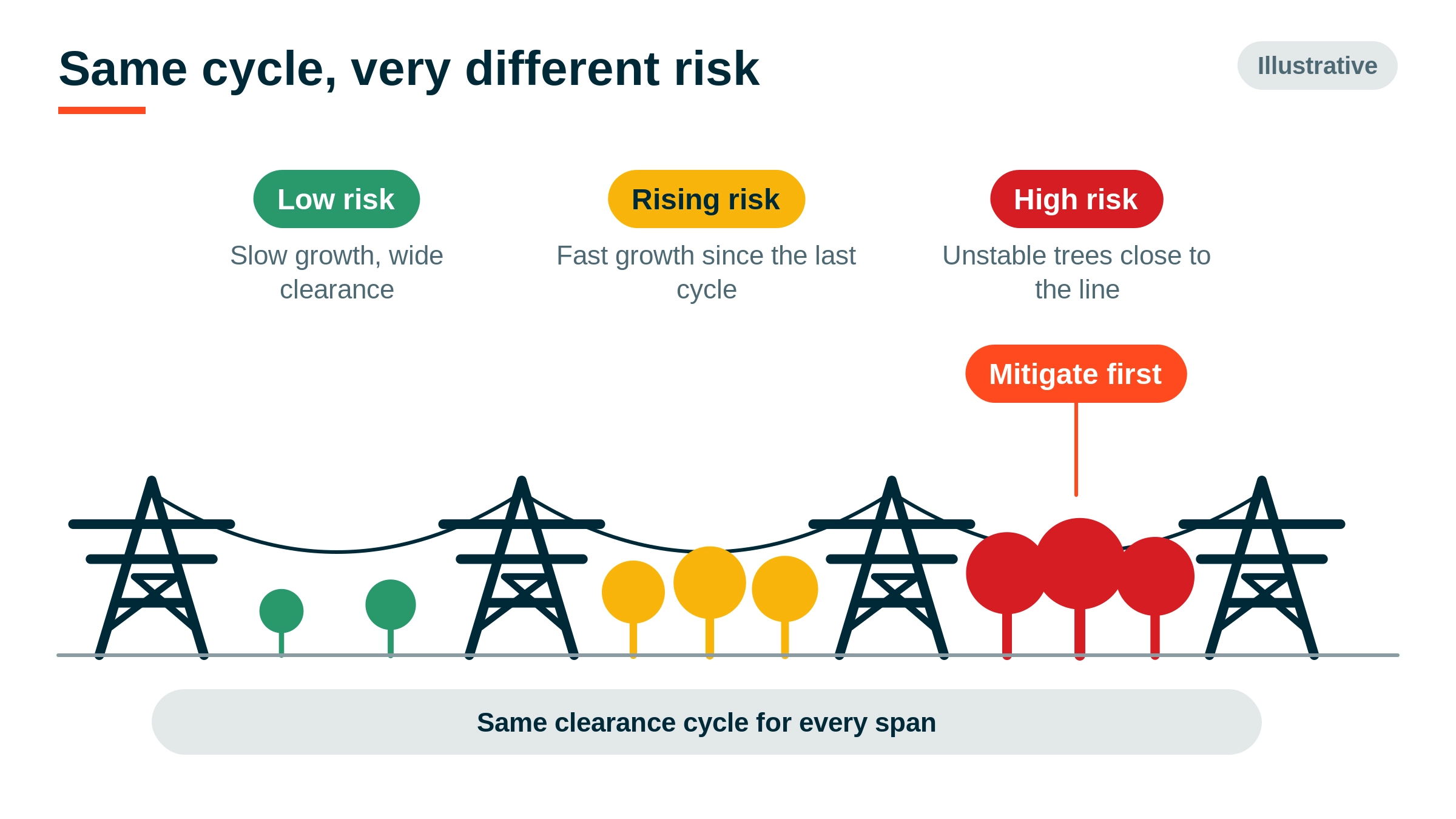
Vegetation risk is becoming a reliability and public-safety issue
Clearance cycles and defined corridors still matter, but vegetation risk does not follow a calendar. Growth rates change, storms and drought affect tree stability, and fire weather alters the consequences. Utilities need to know where vegetation is changing, which assets are exposed, and where mitigation should come first.
- Risk varies by location and over time, which a uniform cycle cannot represent.
- Reliability, wildfire, hazard trees, access, and regulation create overlapping but distinct priorities.
- Better visual and geospatial evidence supports more targeted inspection and mitigation.
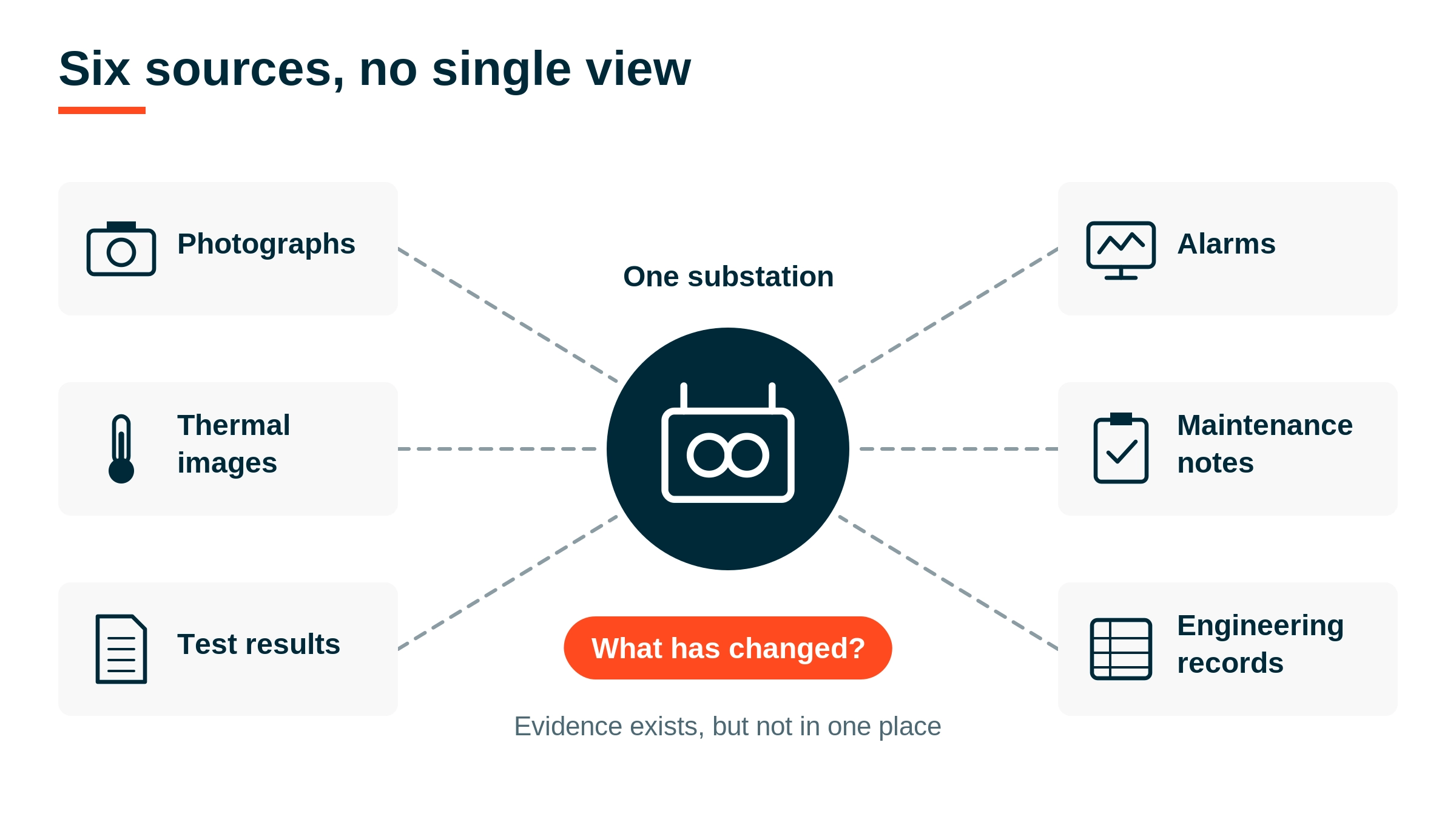
Substations are becoming high-consequence blind spots
Substations concentrate transformers, breakers, insulators, buswork, and protection systems in a small footprint, where failures can carry high network consequences. Evidence about their condition is scattered across photographs, thermal images, test results, alarms, and maintenance notes, so it is hard to see what has changed from one inspection to the next.
- No single inspection or diagnostic method gives the complete view.
- Deterioration shows up as change over time, so repeatability matters.
- Findings gain value when linked to equipment, maintenance history, and criticality.
Part 3
Why this becomes a strategic platform problem
The issue extends beyond individual workflows into investment decisions, governance, and putting AI into operation.

Grid investment decisions are becoming harder to defend
Reinforcement, replacement, resilience, vegetation work, and digitalization all compete for constrained budgets, crews, and delivery capacity. The hard part is not finding worthwhile investments. It is deciding which come first and being able to explain why, internally and externally.
- Investment needs are growing faster than the resources available to deliver them.
- Competing projects rest on different evidence, assumptions, and time horizons.
- Defensible decisions need a traceable chain from field evidence to condition, risk, intervention, and expected outcome.
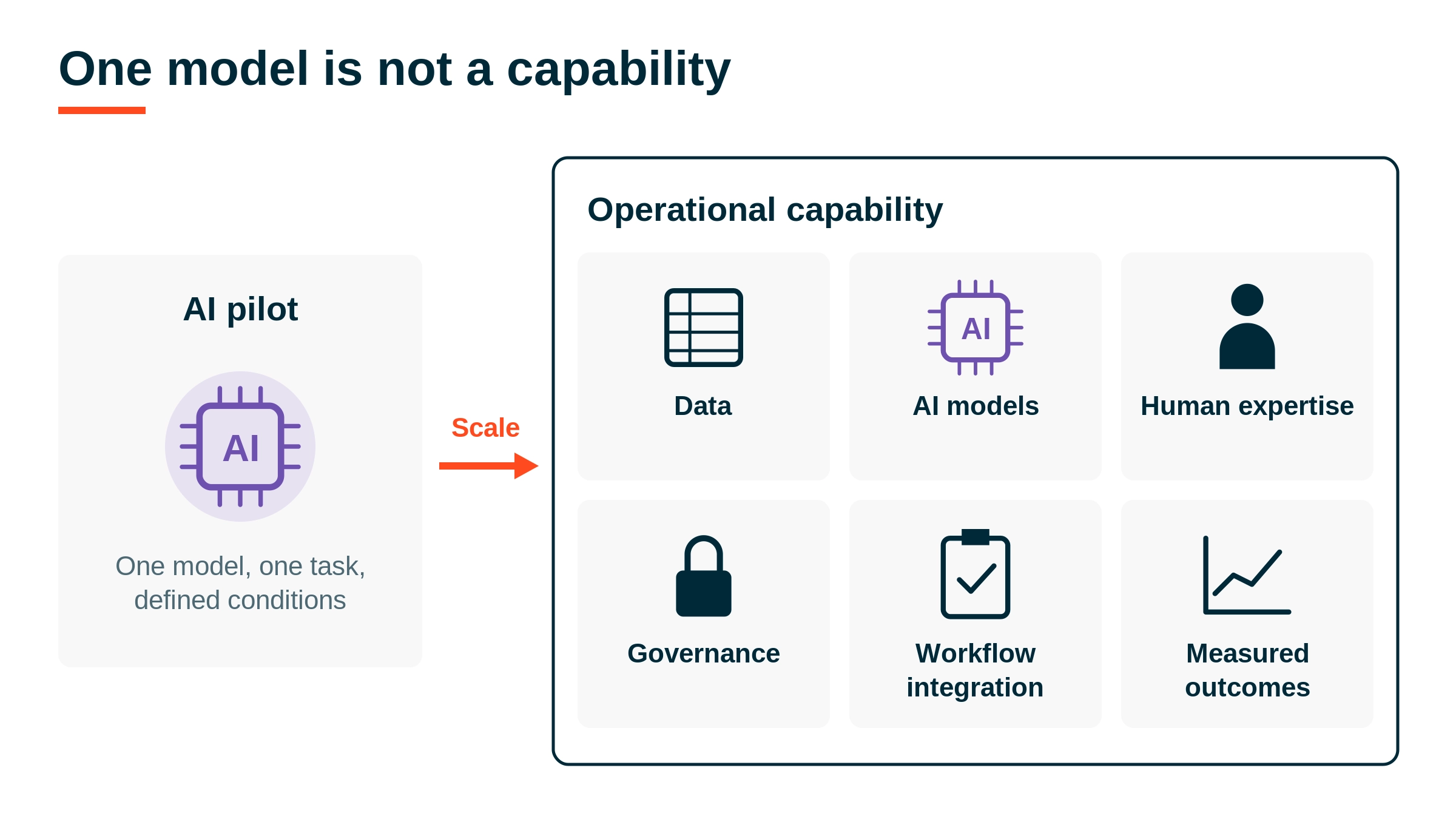
AI pilots do not create grid capability by themselves
A successful pilot proves that a model can perform a defined task under defined conditions. It does not prove that a utility has an operational capability. At scale, performance shifts across asset types, locations, seasons, and data sources, and outputs have to be validated, integrated, governed, and tied to accountable human decisions.
- Pilot accuracy does not demonstrate reliable performance under changing operational conditions.
- AI creates value only when its output changes a real decision or workflow.
- Scaling takes a repeatable platform and operating model, not a growing collection of disconnected demonstrations.
About Arkion
Arkion is the AI-driven grid intelligence platform purpose-built for power grids.
As electric utilities confront aging infrastructure, rising grid complexity, and increasing energy demand, the industry is moving from manual inspection to AI-driven decision intelligence.
Trained on global datasets of annotated distribution and transmission grid images and analyzing more than 1 million grid images every month, Arkion gives utilities and their asset management teams powerful computer vision models that turn sensor data from drones and helicopters into structured grid intelligence — building the system of record for condition-based asset management at scale.
Trusted by Tier-1 operators including E.ON, Avangrid, and Energisa, Arkion powers how utilities operate, invest, and future-proof their grids.
Move from inspecting your grid to understanding it.